Mambu
From CMU Capstone to Fintech Unicorn
Mambu began as Josh's Carnegie Mellon thesis project to expand financial access in emerging markets. He led design on a multidisciplinary team, conducting field research with African microfinance institutions. The work later grew into one of the world's leading fintech platforms.
Overview
As the product strategist and design lead for what would become Mambu, Josh's role was to translate a complex operational problem into a system that actually worked for the people depending on it. The project began with research that found a critical gap: the lack of affordable, scalable portfolio management software for microfinance institutions (MFIs), organizations whose entire mission of alleviating poverty was being undermined by the burden of managing inadequate IT infrastructure.
The design work was inseparable from the operational work. Every interface decision mapped to a real workflow constraint, a staffing reality, or a field condition the team had observed directly. By grounding the platform in rigorous field research and a new cloud delivery model, they built something that freed MFIs to focus on their clients rather than their systems.
“Mambu was one of the first companies to move banking software into the cloud. The team has built a highly composable product in a rapidly-growing market traditionally dominated by large, slow-moving vendors.”

The Challenge
The microfinance sector was growing rapidly, yet the software market failed to serve the majority of organizations.
- High Barriers to Entry: Traditional on-premise software required massive investments in hardware, networking, and IT maintenance.
- The Unserved Majority: Software providers primarily targeted large MFIs with 5,000 to 25,000 clients. Meanwhile, more than 73% of MFIs globally had fewer than 2,500 clients and were left relying on paper, spreadsheets, or unsupported custom tools.
- Disjointed Field Operations: Credit officers spent vast amounts of time traveling from remote villages back to branches just to deliver paper evaluation forms, delaying the loan approval process by weeks.

Discovery & Field Research
To ensure the system actually fit the real-world needs of MFIs, the team conducted over 500 hours of immersive field research in Mozambique.
- Contextual Inquiry: The team traveled with credit officers to markets and remote villages in Maputo, Chimoio, and Xai-Xai to observe their daily interactions with clients and unbanked populations.
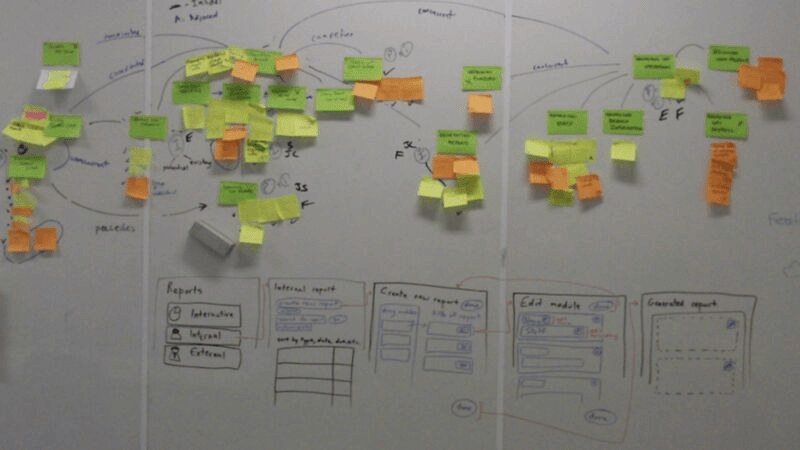
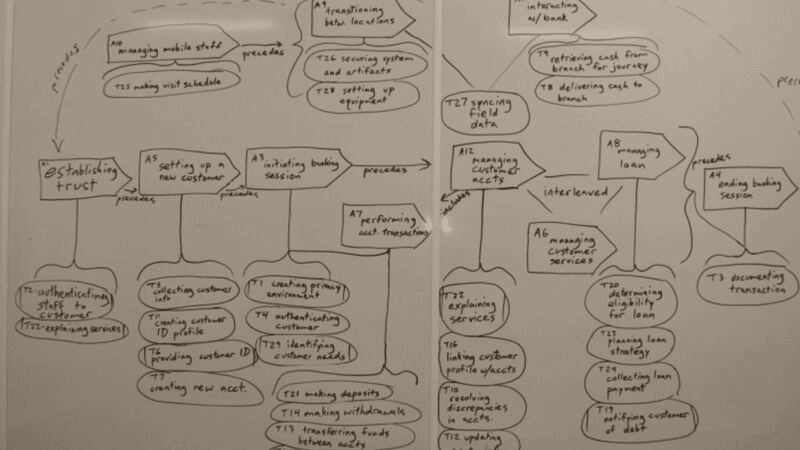
- Workflow Mapping: The team documented the entire MFI lifecycle, mapping out the roles of executives, branch managers, branch staff, and credit officers to understand the complex social and business activities that the software needed to support.



Operational Systems & Field-Driven Solutions
Translating direct field observation into architectural decisions, the team built a system around how MFI staff actually worked – not how software vendors assumed they did.
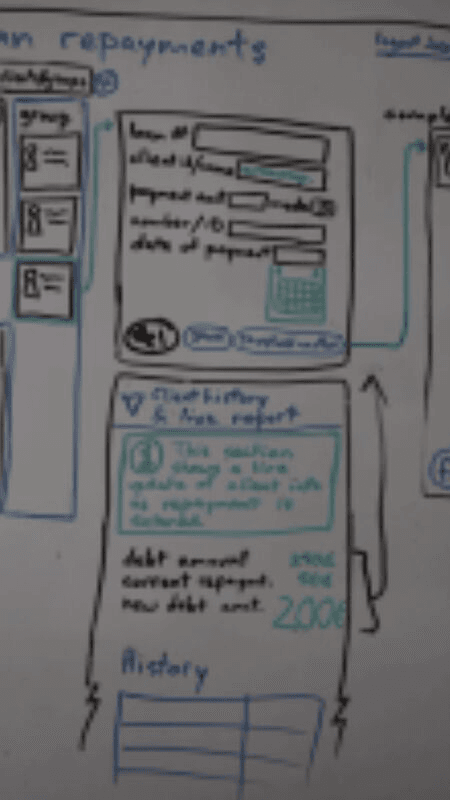
- Stateless Forms & Offline Recovery: Because internet outages are common in emerging markets, Josh designed a stateless form architecture. The system continuously autosaved data, allowing branch staff to keep working during internet downtimes and automatically syncing once the connection was restored.
- Role-Based Activity Feeds: To support the highly social nature of MFI operations, the interface featured chronological activity feeds. Actions and notes were grouped contextually – so if a credit officer logged an observation about a group loan in the field, it was instantly visible to the branch manager reviewing the profile.
- Mobile & Digital Pen Integration: Josh designed workflows to support smartphones and digital pens, allowing field officers to transmit evaluation data directly from the villages. This single data-entry point eliminated the need to transport paper forms, drastically reducing operational costs and loan approval times.
- Integrated Agent Networks & Kiva: The UX accounted for external integrations, such as allowing loan clients to make repayments at local retail banking agents, and streamlining the data pipeline directly to global donor platforms like Kiva.

Business Viability & Impact
The design wasn't just about usability; it was fundamentally tied to a paradigm shift in how microfinance software was delivered. By moving away from heavy, on-premise installations and designing for a scalable, multi-tenant cloud architecture, Josh and team abstracted the immense IT burden away from local branches. This lightweight approach drastically lowered the barrier to entry, enabling smaller MFIs to adopt the platform, scale their operations efficiently, and focus their resources entirely on their core mission of serving unbanked communities.
This work demonstrated that the right operational architecture – built from direct fieldwork rather than assumptions – could unlock an entirely underserved market.